
Inverclyde curling news
 Enlarge photograph
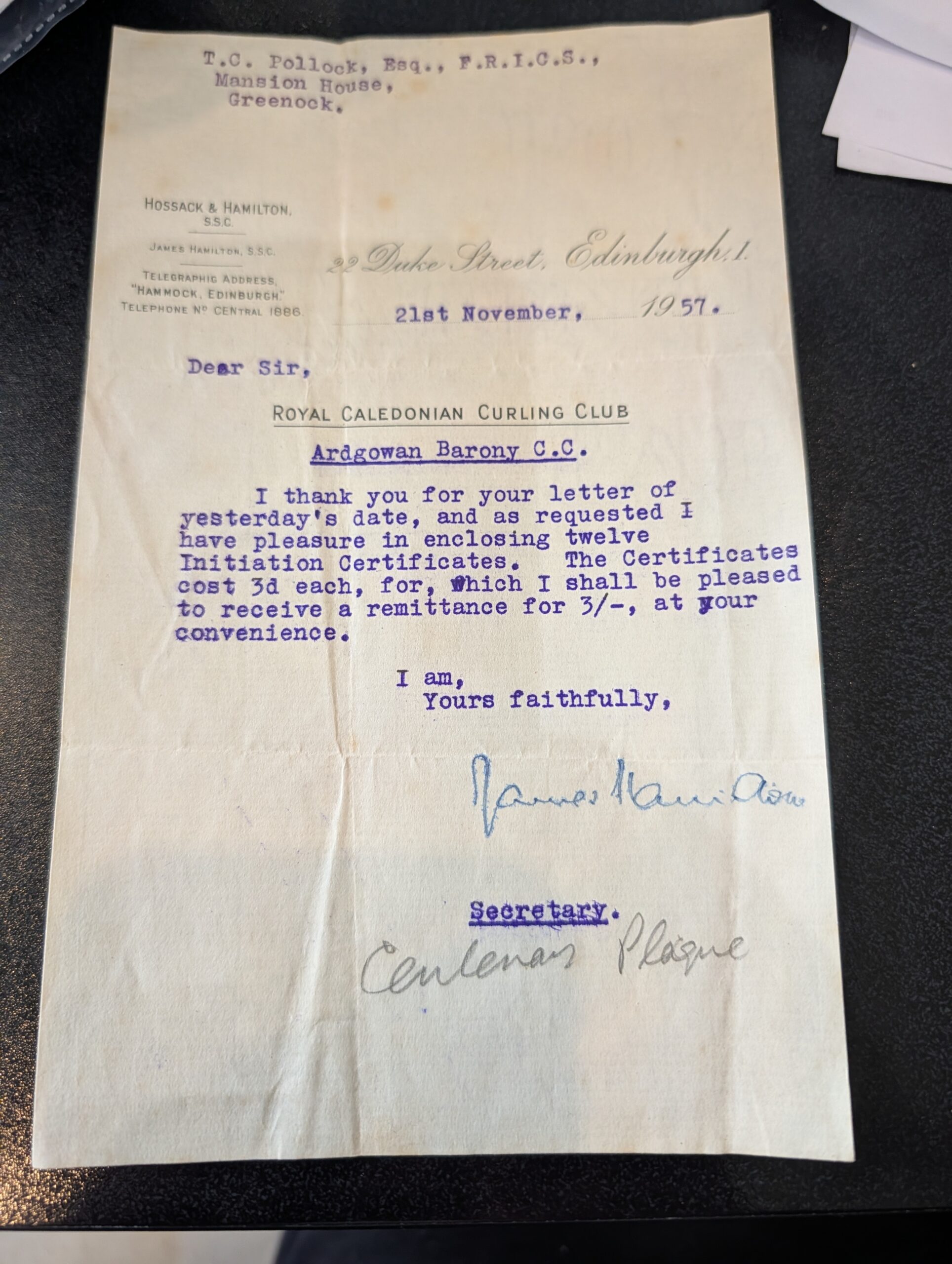
A surviving letter from 1957 has opened a small but fascinating window into the history of Ardgowan Barony Curling Club.
The club was instituted in 1857, making the date of this letter particularly significant: it was written during Ardgowan Barony’s centenary year.
Dated 21 November 1957, the letter was sent from the Edinburgh firm of Hossack & Hamilton on behalf of the Royal Caledonian Curling Club. It was addressed to T. C. Pollock Esq., FRICS, at Mansion House in Greenock.
The message is brief, but it captures an important part of curling-club life at the time.
Following a request received the previous day, the Royal Club enclosed twelve initiation certificates for Ardgowan Barony Curling Club. Each certificate cost threepence, producing a total account of three shillings.
In the currency used before decimalisation, twelve certificates at 3d each amounted to 36 old pennies—or exactly 3 shillings, written as 3/-.
These were more than ordinary pieces of paper. They represented twelve members being formally recorded within the traditions of the Royal Caledonian Curling Club and its wider brotherhood of curlers.
The document also connects Ardgowan Barony to an important period in the development of organised curling across Inverclyde and Renfrewshire.
Historical records show that Ardgowan Barony was already a well-established neighbouring club when Gourock Curling Club was developing during the nineteenth century. Sir Michael Shaw-Stewart, the laird of Ardgowan and president of Ardgowan Barony Curling Club, played a part in Gourock’s admission to the Royal Caledonian Curling Club in 1861.
Ardgowan Barony was also active in competitive curling. A surviving museum record relates to a Royal Club District Medal match contested between Ardgowan Barony and Renfrewshire on 24 December 1908, with material from the occasion preserved through Port Glasgow Curling Club.
The 1957 letter therefore belongs to a much longer story—one involving neighbouring clubs, inter-club matches, formal membership and generations of local curlers maintaining Scotland’s “roaring game”.
The typed wording, Edinburgh address and handwritten signature are characteristic of official correspondence from the period. Yet the document also feels very personal. Someone in Greenock had written requesting certificates for twelve curlers; the Royal Club answered the following day and trusted the club to forward its three-shilling payment at its convenience.
Nearly seven decades after that letter was written—and almost 170 years after Ardgowan Barony Curling Club was instituted—it survives as a reminder that local sporting history is often preserved through the smallest things: a letter, a certificate, a signature and an unpaid account for three shillings.
Documents such as this deserve to be recorded and shared. Together, they help tell the story not only of one curling club, but of the people and communities that kept curling alive across Inverclyde.
IMAGE CAPTION
The Royal Caledonian Curling Club letter dated 21 November 1957, enclosing twelve initiation certificates for Ardgowan Barony Curling Club at a total cost of three shillings.